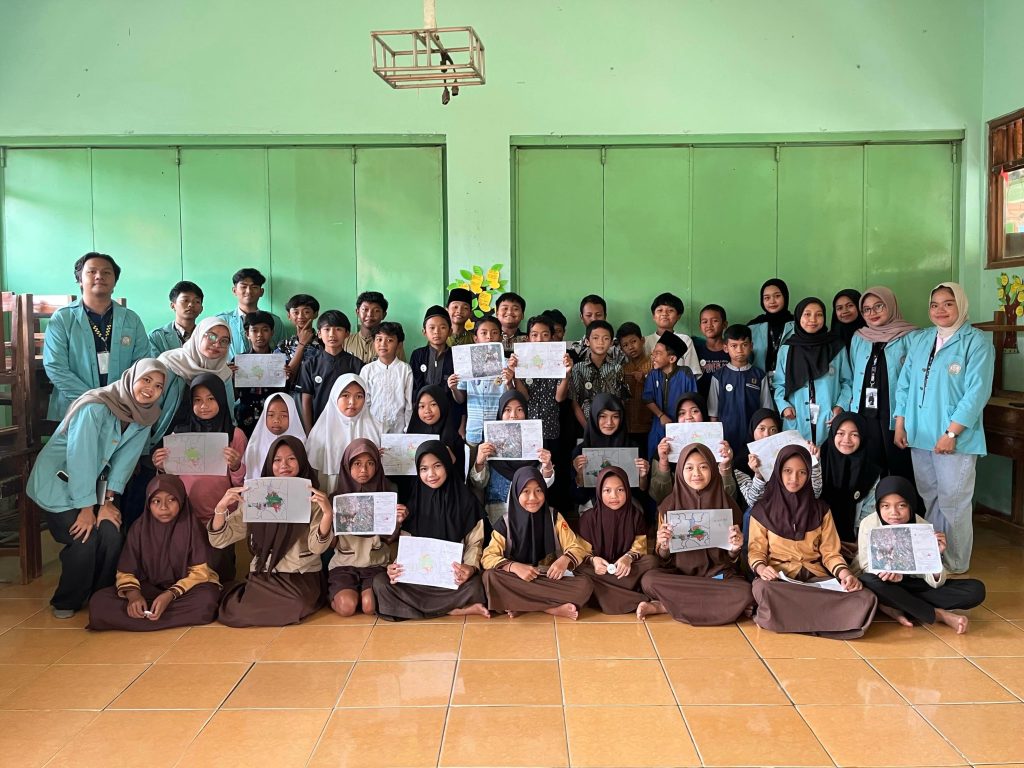
Surakarta, March 15, 2025 – Students from the Geography Study Program, Faculty of Teacher Training and Education, Sebelas Maret University, who are members of the UNS MBKM Grant Team for Village Development 2025, are implementing the SIGAP educational program, “Synergy of Disaster-Conscious Generations,” in Jambeyan Village, Sambirejo District, Sragen Regency.
The SIGAP program aims to improve spatial thinking skills among elementary and junior high school students while also raising early awareness of disaster mitigation. The activity was carried out under the guidance of Dr. Singgih Prihadi, S.Pd., M.Pd., a lecturer in the Geography Education Study Program at FKIP UNS.
The SIGAP activities took place on March 15, 17, and 19, 2025, targeting three elementary schools and one junior high school in Jambeyan Village. SMP N 3 Satu Atap Sambirejo was the first location for the activity on March 15, 2025, followed by SD Negeri Jambeyan 3 on March 17, 2025, SD Negeri Jambeyan 2 on March 18, 2025, and concluded at SD Negeri Jambeyan 1 on March 19, 2025.
The head of the UNS MBKM Grant Team for Village Development 2025 in Jambeyan Village, Risam Kastamsa, said, “At the most basic level, this activity is carried out so that students have the ability to think spatially. Furthermore, it is hoped that students can understand the geographical conditions around them and learn the basics of mitigation against possible disaster threats.”
During the activity, students were introduced to the basic concepts of maps, their components, and the use of maps to understand the surrounding environment. The activity was conducted interactively through lectures, group discussions, and hands-on practice in delineating a map of land use in Jambeyan Village using tracing paper and colored pencils.
“It was an extraordinary experience for the students to learn about maps while coloring. It hones their ability to recognize their surroundings,” said the Principal of Jambeyan 2 Public Elementary School. The results of the group practice were then presented by student representatives as a form of reflection and evaluation of the material they had learned. In addition to fostering curiosity, this activity also encouraged students to be more sensitive to the geographical conditions of their environment, especially those related to potential disasters such as landslides, which are a major threat in the area.