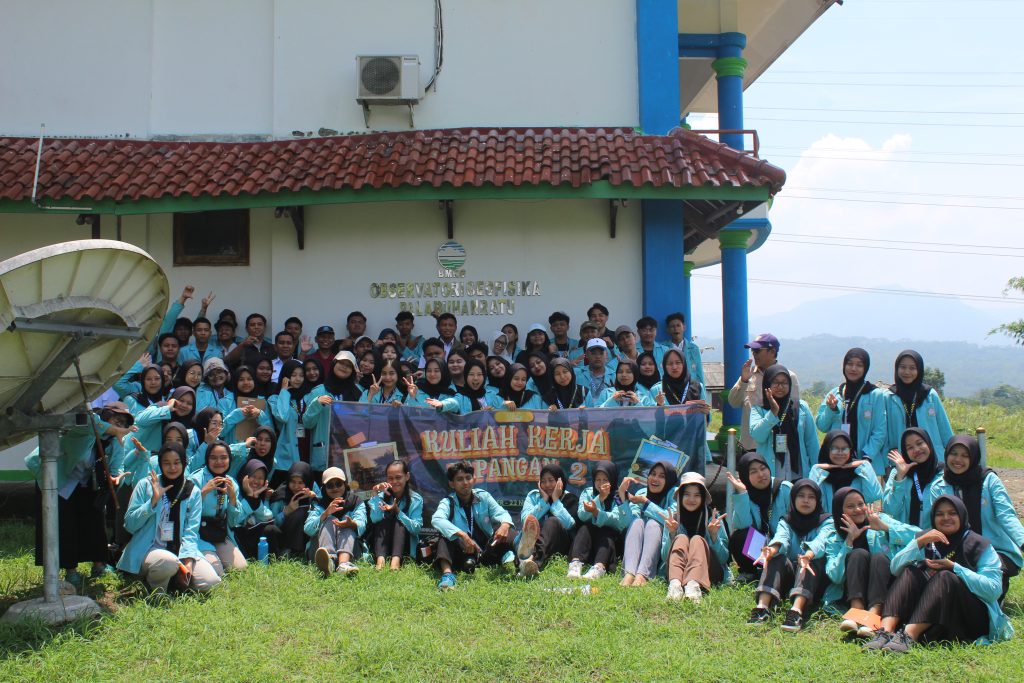
Surakarta, November 22, 2024 – Students from the 2022 Geography Education class at the Faculty of Teacher Training and Education (FKIP) of Sebelas Maret University (UNS) successfully completed Field Work Lecture 2 from November 18 to 22, 2024. This activity was designed to deepen students’ understanding of geography through hands-on fieldwork, guided by all Geography Education lecturers from UNS.
The theme of this activity was divided into five areas of study, namely Physical Geography, Technical Geography, Human Geography, Territory and Disasters, and Education. The location was chosen at Ciletuh Geopark, which is famous for its natural beauty and unique geological structure, with the hope of providing new insights and valuable experiences for students.
During the five-day activity, students were guided through the research process, which included various stages, from pre-research and data collection to the presentation of results. Students were divided into small groups according to predetermined research themes so that they could focus more on observation and analysis.
In Physical Geography studies, students observed and analyzed various geological and geomorphological phenomena found in Ciletuh Geopark, including rock structures, erosion, and soil formations. This activity provided an in-depth understanding of the natural processes that shape the landscape. As well as an analysis of the level of erosion hazard in Ciletuh.
Meanwhile, in Engineering Geography, students are taught mapping techniques using drones, which produce detailed 1:5000 scale maps and toponymic mapping in Ciletuh. This is an important skill for geography students who focus on spatial and infrastructure planning.
Human Geography studies provide students with the opportunity to analyze local disaster knowledge and the development of tourist destinations. Students conduct interviews and surveys with local residents to examine how their social and cultural lives are affected by local geographical conditions.
Regional and disaster studies teach students to examine the structure and polarity of the Ciletuh Geopark and Multi-Risk Disasters. This theme is highly relevant given the geographical conditions that are prone to disasters. Students gain a deep understanding of how geological phenomena, such as landslides and earthquakes, can affect communities and the environment. By understanding disaster aspects, it is hoped that students will also be able to formulate better disaster mitigation strategies in the future. In the field of education, students are directed to assess the community’s understanding of the geopark in Ciletuh.
During the activity, the entire process was guided and supervised by lecturers who are experienced in their fields. They provided constructive direction and input, and helped students overcome challenges encountered during field research.
The head of the activity committee said in a statement, “The entire activity aims to train students to think scientifically. We hope that through this Field Work Lecture, students can gain skills and experience that can be applied in further studies and in the professional world.”
With this training, it is hoped that students can apply the knowledge they have gained in class to real-world practice, while also increasing their awareness of the importance of protecting and preserving the environment.