PRESS RELEASE: Geography Education Study Program of FKIP UNS Hosts the 3rd ICoAGPG and PIT IGI XXVIII 2026
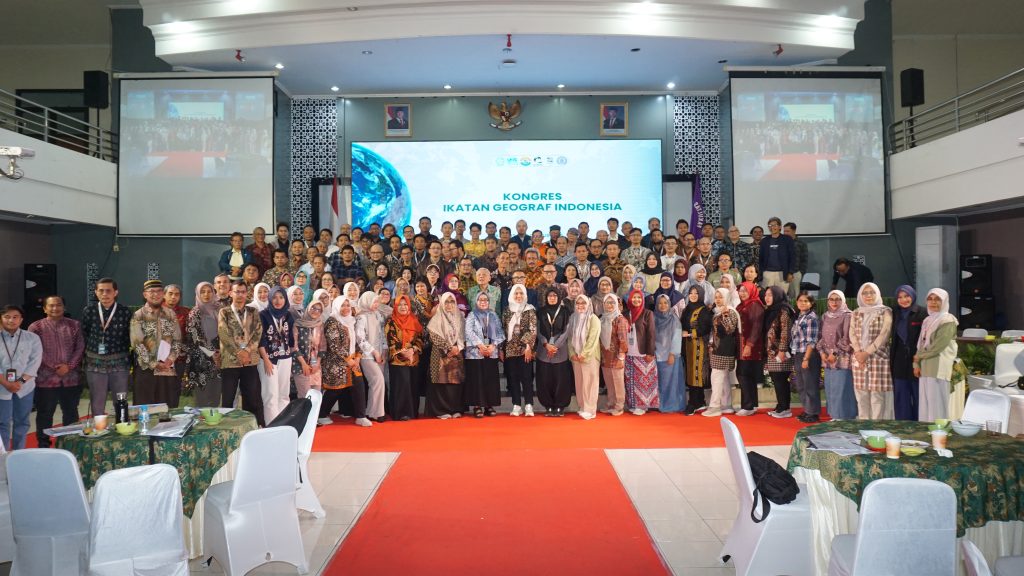
Surakarta, Indonesia – August 6–7, 2026 – The Geography Education Study Program, Faculty of Teacher Training and Education (FKIP), Sebelas Maret University (UNS) Surakarta successfully held the 3rd International Conference on Anthropocene, Global Environmental Change, and Powerful Geography (ICoAGPG) 2026, which was held in conjunction with the 28th Annual Scientific Meeting (PIT) of the Indonesian Geographical Association (IGI) and the IGI Congress. Under the theme “Geo-Ecological Systems in the Age of Artificial Intelligence: Challenges for Sustainability, Human Responsibility, and Disaster Preparedness,” this event was held in a hybrid format on Thursday, August 6, 2026, at the Hall of Building F, FKIP UNS, and was attended by 260 participants from various universities, government agencies, and environmental and disaster management practitioners from both within and outside the country.
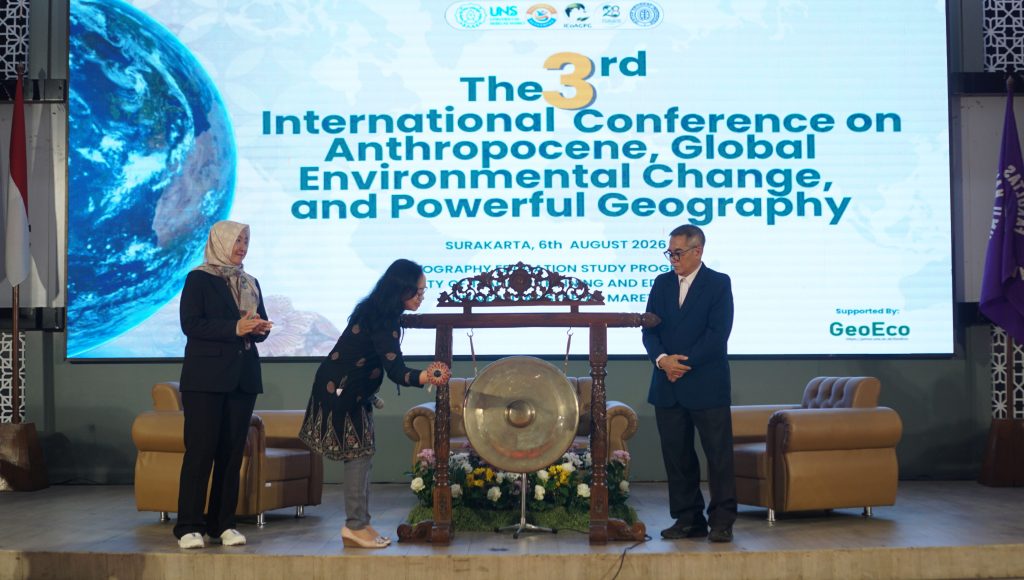
The series of events was officially opened by the Vice Dean for Academic Affairs and Research at FKIP UNS, Prof. Dr. Paed. Nurma Yunita Indriyanti, S.Pd., M.Si., M.Sc., following remarks by the Chair of the Indonesian Geography Association, Prof. Dr. Muhammad Dimyati, M.Si., as well as a report by the Chair of the Organizing Committee and Head of the Geography Education Study Program at FKIP UNS, Dr. Pipit Wijayanti, S.Si., M.Sc. The main theme of this year’s conference highlights the importance of geography’s role in addressing the challenges posed by the transformation driven by artificial intelligence technology and global environmental dynamics, as well as issues of sustainability and disaster preparedness in the Anthropocene era.
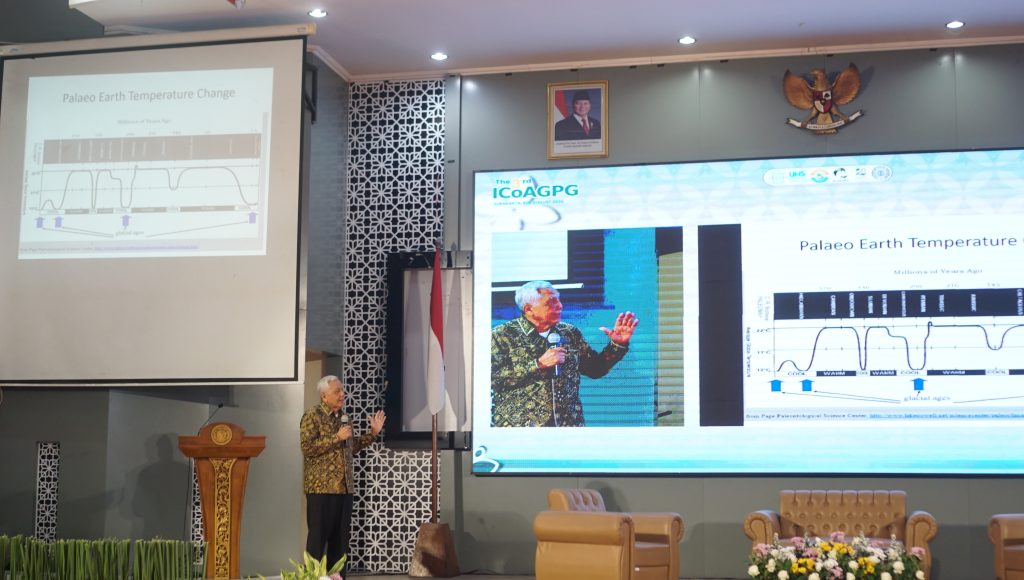
Serving as the keynote speaker, Prof. Dr. Suratman Worosuprojo, M.Sc., from the Faculty of Geography at Universitas Gadjah Mada, delivered a presentation titled “Save Our Earth from Climate Change and Global Warming.” In his presentation, Prof. Suratman encouraged participants to understand the interrelationships among the Earth, climate, and people by reviewing paleoclimate history through the acceleration of global warming driven by current human activities. He outlined the various long-term impacts of climate change on Indonesia, ranging from hydrometeorological disasters and water crises to health issues and the threat of submersion of Java’s northern coastal areas due to rising sea levels. Prof. Suratman also emphasized the importance of implementing the Paris Agreement and Indonesia’s Nationally Determined Contribution (NDC) and encouraged pentahelix collaboration among the government, academia, the business sector, communities, and the media in climate adaptation and mitigation efforts. Several best practices from Gadjah Mada University were presented as concrete examples, including the River School program, the Srikandi Sungai Indonesia movement, climate-resilient villages, and the use of simple technologies such as biopores and rainwater harvesting for community-based climate adaptation.
The conference also featured five invited speakers from various domestic and international institutions, who presented their papers both in person in Auditorium F and online via Zoom:
1. Prof. Dr. Drs. Eko Haryono, M.Si., from Gadjah Mada University, opened the first invited speaker session in person, presenting on the conference’s overarching theme of geo-ecological systems in the era of artificial intelligence, as well as challenges related to sustainability and disaster preparedness.
2. Associate Prof. Dr. Brent Doberstein from the University of Waterloo, Canada, participated online with a presentation titled “Human Responsibility in Climate and Hazard Adaptation Across Geographic Scales of Ecological Systems.” In his presentation, Prof. Doberstein emphasized that human responsibility in adapting to climate change and disasters is multifaceted, relational, and multiscale, encompassing six dimensions of responsibility: self-preservation, responsibility toward others, accountability for damage caused, responsibility toward nature, responsibility arising from agreements and legal institutions, and responsibility to act amid future uncertainty. He concluded his presentation by emphasizing that the fundamental question is no longer whether humans have a responsibility to adapt, but rather how that responsibility is translated into concrete actions across various scales of geo-ecological systems, from the individual to the global level.
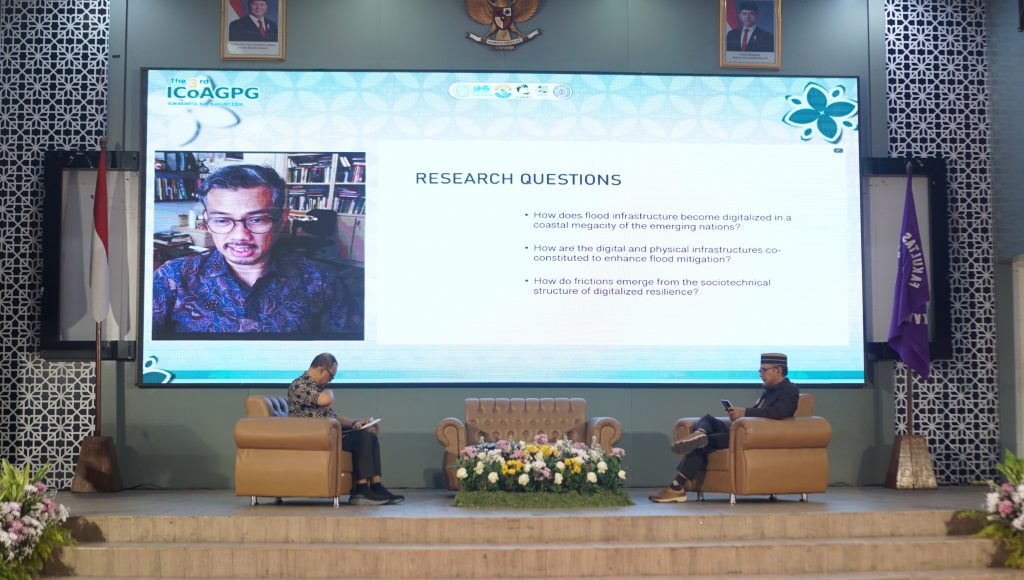
3. Associate Prof. Sulfikar Amir, Ph.D., from Nanyang Technological University, Singapore, also participated online, presenting a session titled “Digitalizing Resilience: Flood Infrastructure and Digital Technologies in the Megacity of Jakarta.” In his presentation, Prof. Sulfikar highlighted a case study on the digitization of flood-control infrastructure in Jakarta, a city with over 11.7 million residents and vulnerable to flooding. He explained the framework of sociotechnical resilience, which views disasters as processes occurring simultaneously within infrastructural, institutional, political, cultural, and epistemological domains. Through inter-agency collaboration—such as between Jakarta Smart City, the Regional Disaster Management Agency, and the Water Resources Agency—the integration of digital technology has proven quite successful at the governmental level, although Prof. Sulfikar also highlighted several emerging frictions and the importance of strengthening the participation of citizens and vulnerable communities in future flood resilience efforts.
4. Dr. Annisa Triyanti from Utrecht University in the Netherlands presented a talk titled “Governance for Sustainable and Disaster-Resilient Geo-Ecological Systems.” In her presentation, Dr. Triyanti highlighted the latest data on global climate conditions—including a global temperature increase of 1.55°C above the pre-industrial average and record-high CO₂ concentrations in the atmosphere—and linked these to various challenges in climate adaptation governance in Indonesia. She highlighted case studies of the coastal areas of Demak and Semarang in Central Java, which face threats from rising sea levels, land subsidence, and coastal erosion, and presented nature-based solutions centered on mangrove restoration as an adaptation strategy. Dr. Triyanti also emphasized a number of governance challenges that still exist, ranging from fragmentation among stakeholders, power imbalances, and issues of equity and inclusion to the lack of available data to monitor progress toward climate resilience.
5. Prof. Dr. Chatarina Muryani, M.Si., from Sebelas Maret University, delivered an in-person presentation to conclude the series of invited speaker sessions with a talk titled “The Complexity Problems of the North Java Coast.” In her presentation, Prof. Chatarina examined three major issues plaguing the northern coast of Java (Pantura): coastal erosion, tidal flooding, and land-use planning challenges. She explained how land subsidence along the Pantura is driven by rapid coastal urban development, land-use conversion, and heavy vehicle traffic, a situation exacerbated by the massive conversion of mangrove forests into fish ponds dating back to the 1970s and 1980s. She also presented the latest data on mangrove loss in the Semarang metropolitan area and projections of the impact of infrastructure development—including the Pantura toll road—on mangrove coverage in Central Java. Prof. Chatarina further highlighted the rapid growth of industrial zones along the northern coast of Java, stretching from West Java through Central Java to East Java, which has driven the conversion of coastal land into industrial, commercial, and residential areas. She emphasized that this conversion of coastal land cannot be simplified as merely good or bad, but requires a balanced consideration of various aspects. In closing, she offered several important points for policymakers: that the interests of local communities must not be overlooked; that green belts must remain a priority; that sustainable development must address the management of solid, liquid, and gaseous waste; and that spatial planning must be based on environmental conservation and disaster mitigation.
Following the main presentation session, the event continued with parallel presentation sessions as a forum for disseminating research findings by the presenters, followed by the Indonesian Geographers Association Congress that evening. At the Congress, a new chair of the Indonesian Geographers Association (IGI) was elected: Prof. Drs. Projo Danoedoro, M.Sc., Ph.D., a full professor in the field of remote sensing for landscape ecology at the Faculty of Geography, Universitas Gadjah Mada. It is hoped that the election of Prof. Projo Danoedoro will bring a new direction and strengthen the IGI’s role in the development of geography as well as its contribution to environmental and disaster-related issues in Indonesia.
As part of the series of activities, on the second day, Friday, August 7, 2026, a field trip was organized to the Gunungsewu UNESCO Global Geopark in Pacitan Regency. Participants were taken to visit three geotourism sites: Goa Gong, known for its distinctive karst cave features and speleothems; the Maron River and Klayar Beach, which showcases coastal geomorphological dynamics. This activity was designed as a field study to deepen participants’ understanding of geological phenomena, geomorphology, and environmental dynamics through firsthand experience.
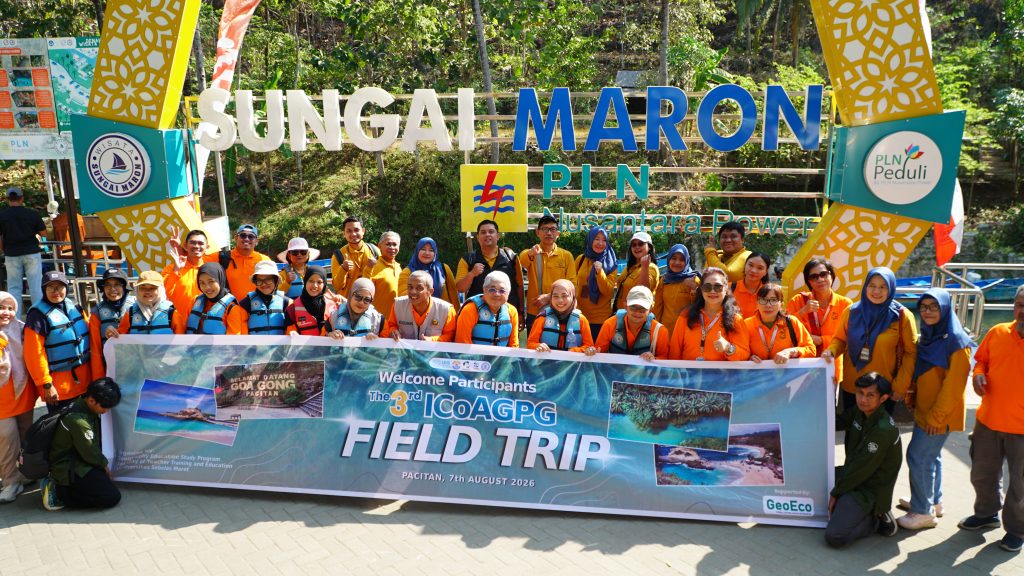
Through the hosting of the 3rd ICoAGPG, PIT IGI XXVIII, and the 2026 IGI Congress, the Geography Education Study Program at UNS hopes to continue strengthening the role of geography in addressing global challenges in the Anthropocene era while also strengthening cross-institutional collaborative networks at both the national and international levels to support the development of education, research, and community service.
Organizer
Undergraduate Geography Education Study Program
Faculty of Teacher Training and Education (FKIP)
Sebelas Maret University (UNS), Indonesia
Reporter & Editor: Bimo Bramantio, S.Pd., M.Sc.